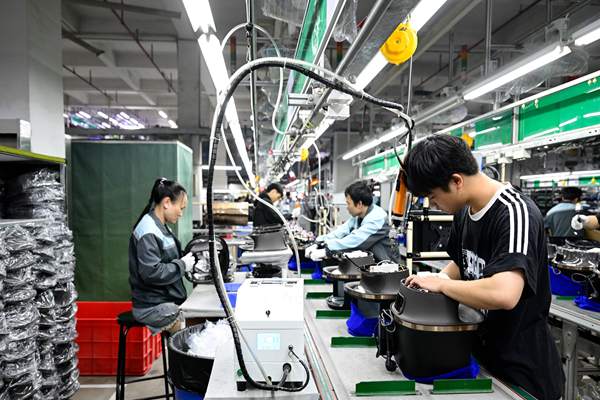
How Mini Rice Cookers Roll Off the Line? Explore the Rice Cooker Assembly Line
1. Production Philosophy
The rice cooker assembly line represents a fascinating intersection of thermal physics, compact electromechanical design, and high-volume lean manufacturing. Unlike large appliance production that relies on heavy robotic cells, rice cooker manufacturing depends on agile, human-centric workflows where precision manual operations coexist with automated testing protocols. The objective is straightforward yet technically demanding: transform stamped metal, molded plastic, and electronic sub-assemblies into a sealed, thermally stable cooking vessel that operates safely at temperatures exceeding 100°C for thousands of cycles.
2. Line Configuration and Takt Design
Modern rice cooker assembly lines are typically arranged in a linear, single-piece-flow configuration. Workstations are spaced at intervals calculated by takt time—the precise rhythm between unit completions.
Key Layout Characteristics:
-
U-shaped or straight-line flow depending on factory footprint and monthly capacity targets.
-
Overhead tool balancers suspend electric screwdrivers and torque guns, keeping bench surfaces clear.
-
Component kanban racks flank each station, organized by assembly sequence to minimize operator motion waste.
-
Conveyor segments use pallet-based carriers sized to the appliance footprint, indexed by pneumatic stops at each workstation.
The line speed is rarely fixed. Engineers adjust takt time seasonally, slowing the rice cooker assembly line during new model introductions and accelerating it when manufacturing mature SKUs.
3. The Thermal Core: Inner Pot and Heating Plate Integration
Every rice cooker is built around a single thermal event: the transfer of energy from an electric heating source to water-soaked rice. Achieving uniform heat distribution begins at the very first assembly stations.
Inner Pot Preparation The inner pot arrives at the line as a pre-formed aluminum vessel. Its exterior may carry a heat-resistant coating, while the interior features a non-stick coating—typically ceramic or fluoropolymer—cured in a separate batch process. Operators perform incoming visual checks for coating pinholes or rim dents, because any surface imperfection will propagate into cooking performance failures in the field.
Heating Plate Marriage The heating plate (or cast aluminum disc with embedded tubular elements) is fastened to the base frame using spring-loaded retainers. This interface is mission-critical. Operators must verify that the plate’s crowned surface matches the concave base profile of the inner pot. A mismatch as small as 0.5 mm creates an air gap, producing thermal hotspots that scorch starch and ruin texture.
4. Electrical Architecture and Safety Systems
Rice cookers are deceptively complex electrically. Beneath the plastic shell lies a network of power distribution, sensor feedback loops, and redundant safety interlocks.
Wiring Harness Routing The wiring harness is routed through molded channels in the outer housing. Operators secure conductors with adhesive cable clips, ensuring that high-temperature wires remain isolated from the heating plate perimeter. Strain relief at the power entry point prevents wire fatigue during consumer use.
Control Panel and PCB Integration At the electronics station, the control panel—whether a simple mechanical switch plate or a microcomputer-driven membrane interface—is connected to the main PCB. Fuzzy-logic models receive their firmware flash at this stage. Technicians verify LED segment illumination and button tactile response before the sub-assembly moves forward.
Safety Components Two devices protect against thermal runaway:
-
The NTC thermistor (negative temperature coefficient sensor) provides real-time temperature feedback to the control board.
-
The thermal fuse acts as a non-resettable fail-safe, permanently cutting power if the heating plate exceeds design limits.
Both components are positioned with millimeter accuracy. A misplaced sensor reads ambient housing temperature rather than plate temperature, resulting in undercooked rice. A poorly seated thermal fuse creates a latent fire risk.
5. Lid Assembly and Steam Management
The lid is not merely a cover; it is a pressure-regulating, steam-managing subsystem. Depending on model specification, lid complexity varies dramatically.
Standard Lid Configuration
-
Inner lid plate: Removable for cleaning, often with a silicone perimeter gasket.
-
Steam vent: A calibrated orifice that releases excess vapor without boiling over.
-
Hinge mechanism: Provides smooth opening through torsion springs or friction cams.
Pressure Cooker Variant Advanced models incorporate a pressure valve, locking cams, and multiple sealing rings. The lid assembly must withstand internal pressures well above atmospheric levels. On the rice cooker assembly line, technicians perform a seal-seating verification: the silicone gasket must compress uniformly around the pot rim with no twists or gaps.
6. Ergonomics and Operator Workflow
The photograph reveals a distinctly human-scale manufacturing environment. Unlike automotive or refrigerator plants dominated by orange robotic arms, rice cooker production leverages operator dexterity for intricate tasks.
Workstation Design Principles
表格
| Element | Implementation |
|---|---|
| Bench Height | Adjustable to accommodate standing or seated operation |
| Tool Delivery | Overhead rails with retractable balancers for screwdrivers and crimpers |
| Component Presentation | Shadow-boarded bins arranged in assembly sequence |
| Lighting | Task-specific LED arrays eliminating shadows inside dark housings |
Operator training emphasizes muscle memory for repetitive tasks—torque application, wire routing, and gasket placement—while empowering workers to halt the rice cooker assembly line via andon cords when defects are detected.
7. Quality Gates and Functional Validation
Quality is not inspected in at the end; it is built in through successive verification gates.
Gate 1: Incoming Component Audit Stamped metal parts, plastic housings, and electronic modules are sampled for dimensional compliance before release to the floor.
Gate 2: In-Process Visual Check Operators at mid-line stations inspect for proper screw seating, wire pinch points, and cosmetic housing defects such as sink marks or flash.
Gate 3: Electrical Safety Test Hi-pot (high potential) testers apply elevated voltage between live conductors and accessible metal parts, verifying insulation integrity.
Gate 4: Burn-In and Cooking Simulation The final and most revealing test occurs at the burn-in test station. Each unit is filled with a measured water load and cycled through a full cooking profile. Equipment logs:
-
Heating element current draw
-
NTC thermistor response curve
-
Control panel program accuracy (white rice, brown rice, porridge, keep-warm)
-
Steam vent flow characteristics
Units failing any parameter are diverted to rework. Only appliances passing all gates receive serial number labels and packaging authorization.
8. Continuous Improvement Culture
High-performing rice cooker assembly lines operate under kaizen methodologies. Daily tiered meetings review:
-
First-pass yield rates by station
-
Takt time attainment percentages
-
Defect pareto charts
Engineers deploy poka-yoke (mistake-proofing) devices aggressively: fixture jigs that prevent backward housing installation, sensors that confirm screw presence before pallet release, and software interlocks that block uncalibrated units from advancing.
9. Conclusion
The rice cooker assembly line distills a surprising depth of engineering into a compact manufacturing footprint. From the careful mating of the inner pot to the heating plate, through the precise routing of the wiring harness, to the calibration of the thermal fuse and NTC thermistor, every operation serves a singular purpose: reliable, safe, and consistent rice preparation. The control panel may capture consumer attention with its glossy interface, but the true quality of the appliance is forged on the line—where non-stick coating integrity, lid assembly seal compression, and steam vent functionality are validated one unit at a time. As kitchen technology evolves toward connectivity and multi-functionality, the fundamental disciplines of the rice cooker assembly line—thermal precision, electrical safety, and ergonomic workflow—remain the immutable foundation upon which every next-generation appliance is built.