
Automated door lock assembly line increases your production capacity by 300%
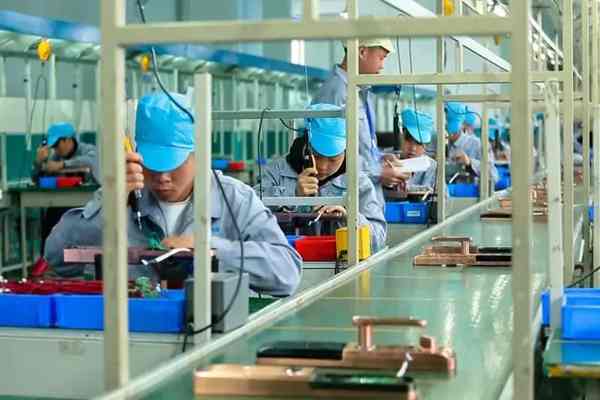
The image captures a door lock assembly line built around meticulous manual operations. Workers in uniform light-gray coveralls and blue anti-static caps focus intently within individually partitioned workstations. The line runs on a pale green anti-static conveyor belt, with copper-toned metal lock bodies arranged in orderly sequence along the track. The scene conveys a distinctive atmosphere—somewhere between laboratory rigor and factory rhythm—that reflects the dual pressures of millimeter-grade precision requirements and mass-production efficiency inherent to lock manufacturing.
Error-Proofing Through Spatial Design
The physical layout of a lock assembly line prioritizes foreign-object control and electrostatic discharge prevention. The transparent acrylic dividers visible in the image serve as more than simple partitions; they form physical error-proofing barriers. The tiny pins, springs, and cams inside a lock cylinder are extremely sensitive to dust, and these dividers effectively isolate operational debris between adjacent stations. Their transparent nature also allows line supervisors to conduct unobstructed visual patrols of the entire line, catching procedural anomalies in real time.
Work surfaces are covered with green anti-static matting, with grounding systems ensuring PCB boards in electronic locks are not damaged by electrostatic discharge during insertion. Blue component bins use color-coding to classify screws, terminals, and sensors, creating visual separation from red tool boxes—this color management forms the foundational layer of the error-proofing system, reducing the probability of picking incorrect similar-looking parts. Each worker has an independent light source and magnifying glass stand; the extensive alignment of pins under two millimeters in diameter and solder joint inspection make optical aids standard equipment rather than optional accessories.
Hierarchical Assembly of the Lock Mechanism
The mechanical reliability of a door lock depends on the precision fit of its internal transmission chain, with assembly processes unfolding layer by layer according to functional modules.
The Cylinder Pre-Assembly Section occupies the front end of the line. Workers press brass pins and springs into the cylinder housing in specific height sequences to create unique bitting codes. This step relies on manual tactile feedback and dedicated press fixtures, with pin height differentials typically controlled within 0.05 millimeters. A single misplaced pin will cause the lock's cross-keying rate to exceed specifications. The yellow-handled tool the worker is holding in the image is characteristic of this operation.
The Clutch and Cam Assembly Section handles the torque transmission mechanism inside the lock body. The motor clutch module of an electronic lock must achieve seamless switching with the mechanical emergency unlocking structure—when powered, the motor drives the gear train for automatic unlocking; when de-energized, handle torque transmits directly to the deadbolt cam. The switching logic between these two power paths is implemented through miniature limit switches and cam structures. During assembly, the switching threshold requires repeated adjustment to ensure neither "electrical interference with mechanical" jamming nor "mechanical freewheeling" failure occurs.
The Panel and Touch Module Integration Section faces the user interaction interface. Connections for fingerprint recognition sensors, keypad interfaces, NFC induction coils, and the main control board involve flexible flat cable bend-radius control and connector insertion/extraction life testing. In the image, some stations show workers using soldering irons for touch-up work, typically appearing in sensor lead reinforcement or antenna impedance matching fine-tuning—RF performance consistency cannot be fully relied upon through SMT mounting alone and still requires manual intervention for optimization.
Embedding Logic of Electronic Systems
Modern locks have evolved from purely mechanical structures to "electromechanical integration" products, requiring the electronic control system to be embedded at the mid-section of the line. The main control board enters the final assembly line as a module after program burning and burn-in testing on an independent dust-free sub-assembly line. Assembly workers must position the board into the reserved cavity of the lock body, connecting motor drive wires, door magnetic detection wires, and emergency power interfaces.
The critical control point in this stage lies in "balancing sealing with heat dissipation." The internal space of a lock body is extremely compact; the board requires conformal coating to resist moisture and salt spray corrosion, while heat from the CPU and motor driver chips must be conducted and dissipated through the metal lock housing. The line includes a thermal grease application station at this point, where dosage precision directly impacts the long-term stability of the electronic system.
Closed-Loop Testing and Verification
The end of the assembly line is not simply a packaging transition but a dense convergence of multiple validation procedures. Each lock must undergo motor start-stop life testing, clutch durability testing, low-battery alarm testing, and anti-tamper alarm trigger testing. The standing worker observing from the rear in the image may be in a quality inspection or process support role, conducting immediate judgment of abnormal products and assigning rework paths.
Some high-end lines also introduce a "simulated door frame" test station, where assembled locks are mounted on standard test door panels to simulate actual opening and closing experiences under different door thicknesses and strike plate gaps. This practice of "reconstructing user scenarios at the end of the production line" marks the transition in lock manufacturing from "conformance to drawing" to "conformance to experience."
Return to Process Essence
The distinctive characteristic of a door lock assembly line is that it cannot pursue high automation like automotive lines, because the irregular structures and miniature components inside a lock body place demands on flexible gripping that exceed current robotic technology boundaries. Nor can it rely on standardized takt times like appliance lines, because assembly times vary significantly between electronic and mechanical locks, or between single-bolt and multi-bolt systems. The densely arranged manual stations and scattered auxiliary tools visible in the image precisely reveal this line's core capability—transforming human fine tactile sense and judgment into replicable quality stability through standardized operating procedures.
Copper-toned lock bodies move slowly along the green belt. The manufacturing process of each lock is a physical interpretation of the word "security." The ultimate product of this assembly line is not merely a door opening mechanism, but the materialized embodiment of a user's trust in spatial boundaries.
- Full cycle support from design to after-sales, please contact us via email: lixu2008@gmail.com