Email:yaming_best@outlook.com Telephone: + 86 137-3657-7326

Come to the Workshop! Let’s Explore Our Printer Assembly Line

Come to the Workshop! Let’s Explore Our Printer Assembly Line

2026-08-24

The Art and Science of Printer Assembly Line Manufacturing In the modern manufacturing landscape, the assembly line stands as one of the most transformative innovations in industrial history. What began as a revolutionary concept in automotive production has evolved into a sophisticated, highly optimized system that drives the production of countless consumer and commercial products. Among these, printer manufacturing represents a particularly fascinating domain where precision engineering, modular design, and streamlined workflow converge to create devices that have become indispensable in offices and homes worldwide. The Foundation of Modern Printer Production A printer assembly line is far more than a simple sequence of workstations connected by a conveyor belt. It is a meticulously choreographed ecosystem where raw components undergo a remarkable transformation, emerging as fully functional printing devices capable of producing high-quality documents, photographs, and graphics. The journey from individual parts to a complete printer involves dozens of specialized processes, each executed with remarkable accuracy and consistency. The typical printer assembly line begins with the preparation of the printer chassis—the structural backbone of every printing device. This chassis serves as...
The Treadmill Assembly Line cuts rework caused by loose parts!

The Treadmill Assembly Line cuts rework caused by loose parts!

2026-07-24

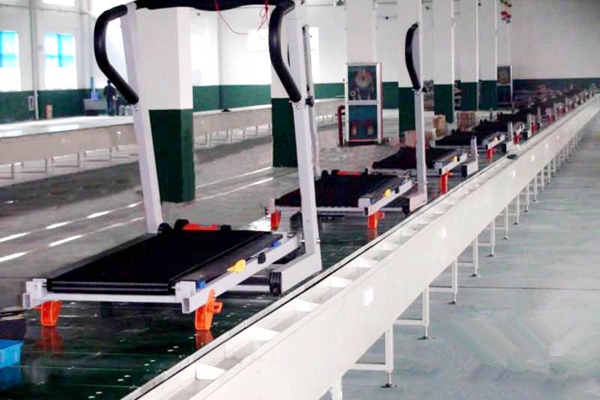
Introduction At the heart of modern manufacturing lies the assembly line, a system that transforms raw components into finished products through a meticulously orchestrated sequence of operations. Our company specializes in designing and building high-performance conveyor assembly lines tailored for the fitness equipment industry, with particular expertise in treadmill production systems. The image before you captures one of our flagship installations: a linear treadmill assembly line engineered for efficiency, precision, and scalability. Section 1: Assembly Line Architecture Conveyor System Design The conveyor system depicted in the photograph represents a modular belt conveyor assembly line, a configuration widely adopted across manufacturing sectors for its adaptability and reliability. The line features a continuous belt-driven platform constructed from heavy-duty aluminum framing, providing both structural rigidity and lightweight maneuverability. The conveyor belt itself is a multi-layer composite material, typically PVC or PU-coated, selected for its abrasion resistance, anti-static properties, and smooth surface finish that prevents damage to delicate components during transit. Workstation Configuration Running along the length of the line are precision-engineered workstations, each positioned at calculated intervals to correspond with specific assembly phases....

Teach you how to test the quality of the rice cooker assembly line!

Teach you how to test the quality of the rice cooker assembly line!

2026-06-14

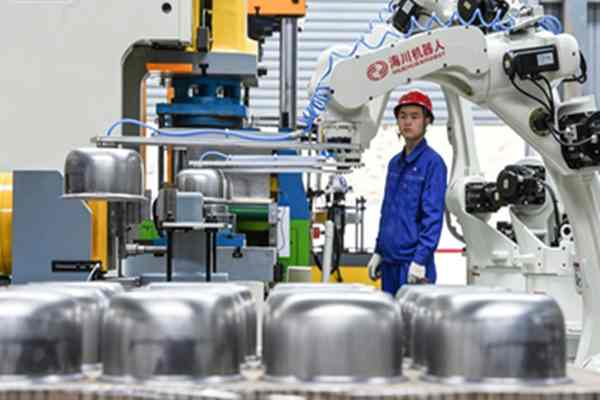
1. Overall Line Structure and Material Flow Layout The image shows an integrated automated processing and assembly line for rice cooker inner pots. It adopts a three-stage series layout: "front-end forming – mid-section processing – rear-end assembly." The line uses silver-gray metal inner pots as the core carriers, combining roller conveyor transport with robotic arm transfer to achieve precise transfer of workpieces between different process islands. The entire line’s material flow design follows the "single-piece flow" principle. The inner pot starts from raw material blanking, then passes through drawing, surface treatment, inspection and sorting, component assembly, and other processes, finally becoming the fully functional main body of the rice cooker. The positioning pallets visible on the ground feature special clamping grooves to ensure that each inner pot maintains a stable posture during transportation, avoiding bumps and scratches—crucial for subsequent spraying and assembly accuracy. 2. In-depth Analysis of Core Process Nodes Drawing and Forming Station The large yellow equipment on the left side of the image is a multi-station hydraulic drawing machine. It is responsible for forming round metal sheets into...

Let's go to the fan assembly line to see how

Let's go to the fan assembly line to see how "wind" is spelled out!

2026-05-07

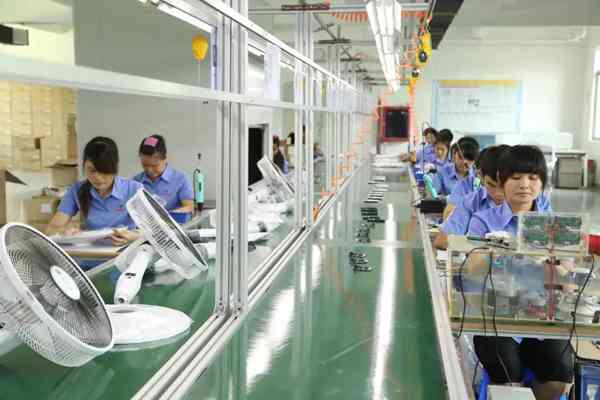
The image reveals a typical home appliance assembly production line, whose process design follows a distinctly different logic from large-scale equipment manufacturing. This fan assembly line demonstrates the production characteristics of "lightweight, modular, and high-efficiency" that define the small home appliance industry. Production Line Structure Analysis The image presents a dual-sided linear belt conveyor system, the mainstream configuration for small appliance assembly. The green anti-static PVC belt operates at constant speed, delivering fan bases to each workstation in sequence. The aluminum profile frame construction offers both lightweight properties and scalability—when products iterate or capacity adjustments are needed, workstation modules can be quickly added or removed without reconstructing the entire line. Workstation spacing design adheres to ergonomics principles of "within arm's reach." Operators work in seated positions, with material bins placed directly in front or to the side, keeping pickup and placement distances within 30 centimeters to minimize non-value-added motions. The integrated lighting and power bridge above the line provides independent task lighting and electric tool power interfaces for each workstation—this integrated design represents a signature feature of small appliance production...

Measures for quality control of TV production lines

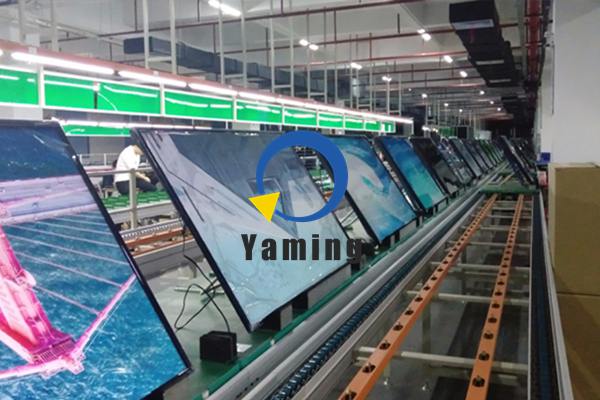
Measures for quality control of TV production lines

2026-04-05

Refrigerator Quality Control: Core Goals, Implementation and Future Trends Core goal: In the fierce market competition, through scientific and systematic quality control, improve product qualification rates, ensure performance and safety, and meet increasingly strict energy conservation and environmental protection standards, thereby enhancing brand competitiveness. 1. Core links and key technologies of quality control Full process coverage Incoming inspection: Strictly control the quality of raw materials and parts. Process control: Monitor key processes such as assembly, welding, foaming, and refrigeration system filling (such as automatic metering of fluorine filling). Finished product inspection: Conduct final inspection on the performance, safety and energy efficiency of the whole machine. Key technology applications Automation and intelligence: Adopt automatic inspection equipment, machine vision, and Internet of Things (IoT) technology to reduce human error and achieve real-time monitoring and defect identification, which can reduce the defect rate by about 20%. Data-driven: Collect and analyze data (such as temperature, humidity, key parameters) through the production monitoring system to ensure product consistency and achieve early warning and rapid traceability of quality problems. 2. System construction that conforms to industry...