
Let's go to the fan assembly line to see how "wind" is spelled out!
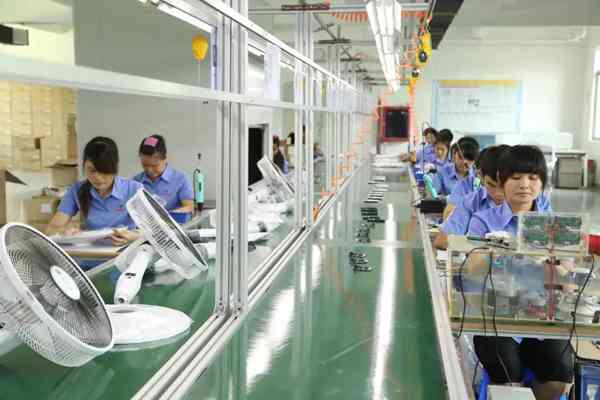
The image reveals a typical home appliance assembly production line, whose process design follows a distinctly different logic from large-scale equipment manufacturing. This fan assembly line demonstrates the production characteristics of "lightweight, modular, and high-efficiency" that define the small home appliance industry.
Production Line Structure Analysis
The image presents a dual-sided linear belt conveyor system, the mainstream configuration for small appliance assembly. The green anti-static PVC belt operates at constant speed, delivering fan bases to each workstation in sequence. The aluminum profile frame construction offers both lightweight properties and scalability—when products iterate or capacity adjustments are needed, workstation modules can be quickly added or removed without reconstructing the entire line.
Workstation spacing design adheres to ergonomics principles of "within arm's reach." Operators work in seated positions, with material bins placed directly in front or to the side, keeping pickup and placement distances within 30 centimeters to minimize non-value-added motions. The integrated lighting and power bridge above the line provides independent task lighting and electric tool power interfaces for each workstation—this integrated design represents a signature feature of small appliance production lines.
Assembly Process Flow
Fan assembly falls within the category of shallow assembly processes, with its core workflow decomposable into:
Base Component Pre-assembly—Initial fixation of motor brackets, control panels, and power cord interfaces. The circuit board testing workstation visible in the image employs in-line powered testing, screening out electronic control functional defects at the semi-finished stage to prevent无效 subsequent investment.
Motor and Blade Module Docking—The power core of the fan product. Assembly lines are typically equipped with torque-controlled electric screwdrivers, ensuring consistent locking force for motor mounting screws to prevent housing deformation from over-tightening or operational noise from insufficient tightening.
Front and Rear Guard Assembly—Installation of safety protection components. This workstation emphasizes error-proofing design, utilizing physical positioning limits in fixtures to ensure guard clips are fully engaged before flowing to the next station, eliminating the risk of missed installations.
Finished Product Functional Testing—Full-function verification of rotation speed, oscillation, timer, and remote control. The independent testing area visible in the far distance of the image may be equipped with wind tunnel-type airflow testing equipment or burn-in test racks, simulating actual usage scenarios for quality control.
Process Management Characteristics
The core competitive elements of small appliance assembly lines lie in changeover efficiency and cost control.
Single-Minute Exchange of Die (SMED) is an essential capability for such lines. Fan products are highly seasonal with rapid style iterations, so fixtures on the line mostly adopt quick-release structures, with mold changeover times compressible to minutes. Material delivery adopts a line-side warehouse + kanban pull model, maintaining several hours of inventory at the line edge, with logistics personnel replenishing on scheduled rounds while operators focus on value-added activities.
Visual management control permeates every detail: workstation numbering is clearly marked, quality warning samples are displayed in prominent positions, and production electronic boards scroll in real-time. The yellow warning devices suspended in the image should be Andon system pull-cord switches—any workstation discovering abnormalities can trigger line stoppage, freezing quality issues at their point of occurrence.
Industry Evolution Trends
Current fan assembly lines are undergoing transformation through automation upgrading. Simple repetitive processes such as screw locking and label application are gradually being replaced by desktop robots; the proliferation of intelligent electric screwdrivers makes assembly data traceable, with torque curves for every screw archivable for future reference; some leading enterprises have introduced vision inspection systems to automatically identify appearance defects such as guard deformation and color variation.
However, the product diversity of small home appliances determines that human-machine collaboration remains the long-term mainstream. The skilled manual operations of workers in the image, in应对 multi-variety flexible production, still possess irreplaceable flexibility and judgment capabilities.
Fan assembly lines may lack the visual spectacle of automotive production lines, but their process design precision is no less rigorous. From belt speed settings to material bin tilt angles, from tool suspension heights to lighting color temperature selections, every detail has undergone quantitative calculation by industrial engineers. This seemingly ordinary green conveyor belt, with its stable and precise operation, supports the cool comfort of countless households during summer days.
- Full cycle support from design to after-sales, please contact us via email: lixu2008@gmail.com