The Treadmill Assembly Line cuts rework caused by loose parts!
Introduction
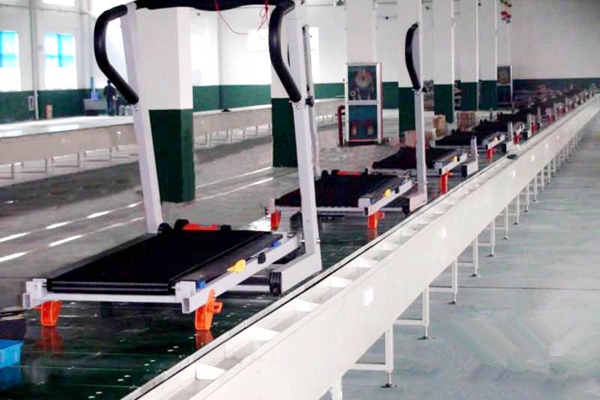
At the heart of modern manufacturing lies the assembly line, a system that transforms raw components into finished products through a meticulously orchestrated sequence of operations. Our company specializes in designing and building high-performance conveyor assembly lines tailored for the fitness equipment industry, with particular expertise in treadmill production systems. The image before you captures one of our flagship installations: a linear treadmill assembly line engineered for efficiency, precision, and scalability.
Section 1: Assembly Line Architecture
Conveyor System Design
The conveyor system depicted in the photograph represents a modular belt conveyor assembly line, a configuration widely adopted across manufacturing sectors for its adaptability and reliability. The line features a continuous belt-driven platform constructed from heavy-duty aluminum framing, providing both structural rigidity and lightweight maneuverability. The conveyor belt itself is a multi-layer composite material, typically PVC or PU-coated, selected for its abrasion resistance, anti-static properties, and smooth surface finish that prevents damage to delicate components during transit.
Workstation Configuration
Running along the length of the line are precision-engineered workstations, each positioned at calculated intervals to correspond with specific assembly phases. The treadmills shown in various stages of completion illustrate the progressive nature of the workflow. Units enter the line as partially assembled chassis and advance through stations dedicated to motor integration, deck installation, console wiring, and final quality verification. This sequential arrangement eliminates redundant material handling and ensures that each unit receives uniform attention at every stage.
Drive Mechanism
The drive mechanism concealed beneath the belt platform comprises a variable-frequency motor paired with a precision gearbox, enabling speed adjustment from 0 to 2,000 mm per minute depending on operational requirements. This variability is critical. Complex wiring stations demand slower belt speeds to accommodate intricate manual operations, while packaging and final inspection zones can run at accelerated rates to maximize throughput.
Section 2: Process Engineering and Workflow Integration
Workstation Ergonomics
What distinguishes our assembly lines is not merely the physical conveyor infrastructure, but the process engineering embedded within the workflow design. Each workstation is equipped with tool balancers, component bins, and ergonomic fixtures positioned within the operator's natural reach envelope, minimizing motion waste in accordance with lean manufacturing principles. The line incorporates pallet-based conveyance. Individual treadmills rest on dedicated carrier pallets that maintain consistent orientation and spacing throughout the circuit, preventing product-to-product contact and ensuring precise stopping accuracy at each station.
Automated Control Systems
The integration of automated control systems further elevates operational efficiency. Photoelectric sensors positioned along the conveyor track detect pallet presence and communicate with a centralized programmable logic controller to regulate belt movement. This intelligence allows for dynamic line balancing. If a station experiences a delay, the system can automatically buffer upstream units or redistribute workload to adjacent stations, preventing cascading bottlenecks that plague traditional fixed-speed lines.
Inline Quality Assurance
Quality assurance is woven directly into the conveyor architecture. Strategic stations incorporate inline testing modules. For treadmills, this includes motor performance validation, belt alignment verification, and emergency stop function checks. Units failing any test are automatically diverted via pneumatic pop-up stops to a dedicated rework lane, ensuring that only compliant products proceed to packaging. This defect containment strategy reduces downstream waste and protects brand reputation.
Section 3: Material Flow and Ergonomic Design
Component Replenishment
The physical layout of the assembly line reflects careful consideration of material flow optimization. Component replenishment occurs through parallel supply lanes positioned beneath the main conveyor, with gravity-fed roller conveyors delivering sub-assemblies such as motors, control boards, and handrail assemblies to workstations precisely when needed. This just-in-time feeding system minimizes work-in-process inventory while preventing line starvation.
Human-Centered Design
Ergonomic design permeates every aspect of the workstation configuration. The conveyor belt height is standardized at 750 millimeters, an optimal working elevation that reduces operator fatigue during extended shifts. Adjustable lighting arrays illuminate task areas without creating glare on electronic displays. Anti-fatigue matting at standing stations promotes circulation during repetitive assembly tasks. These human-centered design elements directly correlate with reduced absenteeism and improved product quality.
Section 4: Scalability and Future-Proofing
Modular Construction
Our assembly line systems are engineered for modular scalability. The bolt-together frame construction allows sections to be added, removed, or reconfigured without welding or structural modification. This adaptability proves invaluable when product lines evolve. Treadmill manufacturers frequently introduce model variants with differing deck lengths or console specifications, and our conveyor systems accommodate these changes through simple pallet redesign and station reprogramming rather than complete line replacement.
Industry 4.0 Readiness
The integration of Industry 4.0 readiness is another cornerstone of our design philosophy. Each assembly line is pre-wired for Manufacturing Execution System connectivity, with Ethernet-enabled sensors and RFID pallet tracking capable of feeding real-time production data to centralized management systems. This digital infrastructure supports predictive maintenance algorithms, quality trend analysis, and Overall Equipment Effectiveness optimization. These capabilities transform the assembly line from a passive production tool into an intelligent manufacturing asset.
System Specifications Summary
| Attribute | Specification | Operational Benefit |
|---|---|---|
| Conveyor type | Modular belt conveyor, PVC/PU-coated | Abrasion resistance, smooth surface |
| Frame material | Heavy-duty aluminum | Rigidity with lightweight construction |
| Speed range | 0 to 2,000 mm/min | Adaptable to complex and simple tasks |
| Workstation height | 750 mm standard | Reduced operator fatigue |
| Conveyance method | Pallet-based carrier system | Consistent orientation, precise stopping |
| Control system | PLC with photoelectric sensors | Dynamic line balancing, delay buffering |
| Quality integration | Inline testing with automatic diversion | Defect containment, brand protection |
| Material supply | Gravity-fed parallel lanes | Just-in-time delivery, reduced inventory |
| Scalability | Bolt-together modular sections | Easy reconfiguration for new models |
| Digital readiness | MES connectivity, RFID tracking | Predictive maintenance, OEE optimization |
Conclusion
This treadmill assembly line represents a comprehensive manufacturing solution that balances mechanical reliability, operational flexibility, and human-centered design principles. By integrating precision conveyor technology with intelligent process control and ergonomic workstation engineering, the system delivers consistent production output while maintaining the adaptability required in the fitness equipment industry.
Our company's expertise ensures that each installation is optimized for the specific product requirements, production volumes, and facility constraints of our clients. From motor integration to final quality verification, every station on this line is engineered to transform components into reliable, high-performance treadmills that meet the exacting standards of modern fitness equipment manufacturing.