
Teach you how to test the quality of the rice cooker assembly line!
1. Overall Line Structure and Material Flow Layout
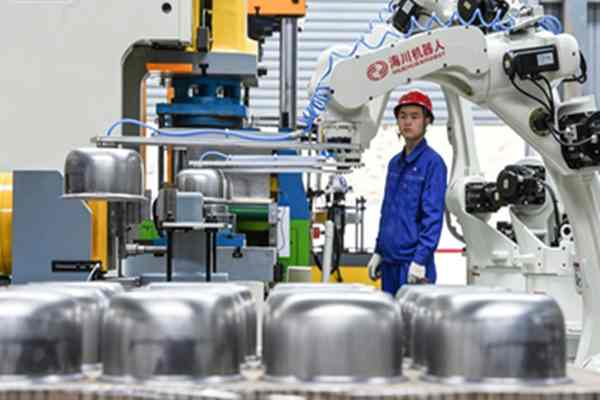
The image shows an integrated automated processing and assembly line for rice cooker inner pots. It adopts a three-stage series layout: "front-end forming – mid-section processing – rear-end assembly." The line uses silver-gray metal inner pots as the core carriers, combining roller conveyor transport with robotic arm transfer to achieve precise transfer of workpieces between different process islands.
The entire line’s material flow design follows the "single-piece flow" principle. The inner pot starts from raw material blanking, then passes through drawing, surface treatment, inspection and sorting, component assembly, and other processes, finally becoming the fully functional main body of the rice cooker. The positioning pallets visible on the ground feature special clamping grooves to ensure that each inner pot maintains a stable posture during transportation, avoiding bumps and scratches—crucial for subsequent spraying and assembly accuracy.
2. In-depth Analysis of Core Process Nodes
Drawing and Forming Station
The large yellow equipment on the left side of the image is a multi-station hydraulic drawing machine. It is responsible for forming round metal sheets into a double-layer composite structure through multiple drawing steps. This process uses progressive die technology to complete continuous operations such as blanking, preliminary drawing, re-drawing, trimming, and flanging in a single machine, capable of producing 15–20 blanks per minute. The wall thickness uniformity of the formed inner pot is controlled within ±0.05mm, directly affecting the heating uniformity and service life of the rice cooker.
Surface Treatment and Coating Station
The drawn inner pot enters a sandblasting or chemical treatment line to remove the surface oxide layer and increase roughness, providing microscopic anchoring points for subsequent non-stick coating adhesion. Modern high-end rice cookers typically use ceramic glaze or diamond powder non-stick coatings. These are evenly applied to the inner wall of the pot via electrostatic spraying or flow coating processes, then cured in a high-temperature sintering furnace to form a wear-resistant surface with a hardness of 9H. Coating thickness is usually controlled at 25–35μm. If too thin, it easily peels; if too thick, it affects heat conduction efficiency.
Intelligent Inspection and Sorting System
The vision system above the robotic arm in the image belongs to the online quality inspection unit. As each inner pot passes through, an industrial camera, in cooperation with a ring light source, performs a 360-degree scan of its outer surface. AI algorithms are used to identify defects such as dents, scratches, and coating flaws. Non-conforming products are automatically picked by the robotic arm and sent to the NG station (defective product collection area), while qualified products continue to the assembly section. The system’s detection speed can reach 60 pieces per minute, with a missed detection rate of less than 0.01%.
Robot-assisted Assembly Section
The six-axis industrial robot on the right side of the image (logo shows "Haichuan Robot") undertakes the task of automatically assembling the inner pot and outer shell. The robot’s end is equipped with a composite fixture combining vacuum suction cups and pneumatic clamping jaws. It first picks the inspected inner pot from the buffer area, accurately positions it into the injection-molded PP shell, and then simultaneously completes the embedding and fixing of the bottom heating plate, temperature control sensor, and magnetic temperature limiter device. The repetitive positioning accuracy of this station reaches ±0.02mm, ensuring that the fitting gap between the heating plate and the bottom surface of the inner pot is controlled within 0.1mm—a key parameter determining the thermal efficiency of the rice cooker and the quality of cooked rice.
3. Process Characteristics of the Production Line
Modular Process Island Design
Unlike traditional linear assembly lines, the rice cooker assembly line adopts a modular architecture of "process island + flexible connection." Equipment within each process island (such as the drawing island, spraying island, and assembly island) is arranged compactly, while islands are flexibly connected by AGVs or conveyor belts. This design allows equipment maintenance or process upgrades on a single island without affecting the entire line. During product changeover, only the tooling on the island needs to be replaced, enabling switching between products of different capacities (3L/4L/5L) within 30 minutes.
Human-Robot Collaborative Work Model
The scene in the image, showing technicians working alongside robots, reflects a typical human-robot collaboration (cobot) concept. Robots are responsible for high-precision, highly repetitive processes that involve certain occupational health risks (such as handling high-temperature parts and heavy assembly), while human labor focuses on flexible judgment, fine adjustments, and exception handling. The production line is equipped with safety gratings and area scanners. When a person enters the robot’s working radius, the robotic arm automatically slows down or pauses to ensure operational safety.
Closed-loop Management of Process Data
Each inner pot is assigned a laser QR code or RFID tag at the entrance of the production line. Over 200 process parameters—such as drawing pressure, spray thickness, sintering temperature, and assembly torque—are recorded throughout the process. Data is uploaded to the MES system in real time and correlated with after-sales feedback from the sales end, forming a closed loop of "manufacturing → use → improvement." For example, if a batch of inner pots shows abnormal coating adhesion, the system can accurately trace the deviation to the atomization air pressure of a specific spray gun, achieving root cause identification.
4. Key Quality Control Nodes
Airtightness Testing
Rice cookers are Class I electrical appliances that come into contact with food. The reliability of their steam valves and sealing rings directly affects safety during use. A helium mass spectrometer leak detector is installed at the end of the production line to conduct negative pressure vacuum testing on the assembled pot body. The leak rate must be less than 1×10 Pa·m³/s to ensure that steam does not escape from unintended paths.
Electrical Safety Testing
Each finished product must pass withstand voltage testing (1500V/1min), ground resistance testing (≤0.1Ω), and leakage current testing (≤0.25mA) to simulate insulation performance under extreme grid conditions. Test data is automatically bound to the product serial number, with an archiving period of no less than 10 years.
Aging Operation Verification
Before leaving the line, each rice cooker is filled with a fixed amount of rice and water and subjected to a complete cooking cycle test: heating from room temperature to boiling, maintaining micro-pressure stewing, and automatically switching to insulation mode. An infrared thermal imager monitors the temperature distribution curve at the bottom of the pot throughout the process, ensuring that the temperature controller’s activation point deviation is within ±2℃.
- Full cycle support from design to after-sales, please contact us via email: lixu2008@gmail.com